What do you need from your payroll software?
Before you start comparing providers, take a closer look at what you need your payroll software to do:
Identify your pain points
Our survey of 250 payroll professionals found that 56% use spreadsheets for payroll processing, 56% duplicate data across multiple places and 49% manually input data. Almost half (48%) also said they piece together data from different reports.
If this sounds familiar, review your current processes to see where your team is spending unnecessary time or where problems are most likely to occur. For example:
- Are employees or managers submitting information manually?
- Does your payroll team need to rekey information held elsewhere?
- Are spreadsheets being used to fill gaps between systems?
- Do HR, payroll, time and attendance, and finance systems share information effectively?
- Is reporting dependent on manually combining information from different sources?
- Are there payroll processes that rely heavily on the knowledge of individual team members?
Rather than starting with a long list of features you think you need, use these pain points to define the outcomes you want from a new system.
Consider size and complexity
What you need from payroll software will depend on the size and complexity of your organisation.
Fewer than 10 employees:
Small businesses with straightforward payroll requirements might not need a comprehensive payroll platform. HMRC offers free Basic PAYE Tools that can perform most payroll tasks for businesses with fewer than 10 employees.
SMEs:
SMEs usually have less people dedicated to payroll, so software should make routine processes easy to manage without adding unnecessary work. Priorities may include:
- Ease of use and straightforward setup
- Automation of routine payroll processes
- Employee self-service to reduce admin
- Integrations with HR, accounting and time and attendance systems
- Training and support where in-house payroll expertise is limited
Large organisations and enterprise:
As payroll becomes more complex, the priorities shift towards control, flexibility and resilience. Organisations managing high employee volumes, complex pay rules or multiple payrolls should consider:
- Advanced automation and configurable processes
- Reliable integrations across HR, workforce management and finance
- Detailed reporting and stronger payroll controls
- Enterprise-grade security
- Implementation and ongoing support, including appropriate SLAs
- Global payroll capability if you employ people outside of the UK
Do you need managed payroll support?
Some providers just offer payroll software that your internal team manages themselves, while others also offer managed payroll services, where the provider takes responsibility for agreed parts of running your payroll.
If you have limited internal capacity or want to reduce the workload for your team, outsourcing to a managed payroll service is worth considering.
Learn more: In-house vs outsourced payroll: How to choose
Do you need a unified platform?
Consider whether you need standalone payroll software or a unified platform that brings payroll together with HR and workforce management in one system.
Organisations with large and complex workforces in particular can benefit from a unified platform. Bringing these functions together can help:
- Reduce manual data entry by allowing employee and workforce information to flow directly into payroll.
- Improve accuracy by reducing duplication and keeping employee information consistent.
- Simplify reporting by bringing HR, workforce and payroll data together.
- Improve the employee experience by giving employees a more consistent way to access and manage their information.
What features should you look for in payroll software?
When comparing payroll software providers these are some of the key features that you should look for and evaluate:
Core functionality
At its core, payroll software should make it straightforward to carry out the day-to-day tasks involved in paying your employees, including:
- Calculating gross and net pay
- Calculating tax, National Insurance and other deductions
- Processing statutory payments
- Managing employee payroll records
- Producing and distributing payslips
- Processing starters, leavers and changes to employee pay
- Producing payroll and year-end reports
These capabilities are standard in many payroll systems; what matters is how easily and reliably the software handles them within the context of your payroll.
Compliance
For UK payroll, check that the software is recognised by HMRC for PAYE reporting and RTI submissions.
It should also keep pace with changing legislation. Automatic updates and built-in compliance checks can reduce manual work and help your team stay on top of tax, pension and statutory requirements.
Automation and AI
The best payroll software should save your team time and reduce errors, so look for platforms that automate repetitive tasks within your payroll process. For example calculating salaries and deductions, processing payments, updating payroll records and producing reports.
AI is becoming a must-have feature too. 91% of payroll professionals we surveyed said they currently use AI in their processes and 66% said they expect it to shape the function most over the next year.
In advanced platforms AI can be used for things like identifying anomalies, flagging potential errors and automating specific workflows. When comparing platforms, consider how this could enhance your current processes.
Real-time payroll
Real-time payroll software recalculates pay as information changes, giving your team an up-to-date view of payroll throughout the month, rather than at the end of the pay cycle.
This can help teams spot potential errors earlier, reduce last-minute corrections and maintain a more up-to-date view of payroll and people costs. Ask providers when payroll calculations are updated and how quickly changes are reflected in an employee’s pay.
HR and workforce management integration
Efficient payroll relies on data from across your organisation, so consider how the software will integrate with your HR and workforce management systems if these aren’t natively connected. Employee details, absences, hours worked, shifts and overtime should be able to flow into payroll without your team manually transferring information between systems.
The fewer manual hand-offs between systems, the easier it is to keep payroll information accurate and up to date.
Self-service and financial wellbeing
Payroll software should make it easy for employees to access and understand their pay. Look for self-service features that give employees access to payslips and pay information without having to contact HR or payroll.
You may also want to consider features that support financial wellbeing, such as financial education, budgeting tools and Earned Wage Access, which allows employees to access a proportion of wages they’ve already earned before payday.
Reporting and analytics
78% of payroll professionals we surveyed agree that payroll plays an integral part in identifying data trends, analysis and forecasting. If you want your payroll data to support better decision-making, prioritise software with intuitive, flexible reporting that makes those insights easy to access.
Consider whether reports can be customised and payroll data analysed alongside wider workforce information, helping HR, payroll and finance understand areas such as people costs, overtime, absence and workforce trends.
Security
Payroll software holds highly sensitive employee and financial data, so robust security is non-negotiable. Look for features such as multi-factor authentication (MFA), single sign-on (SSO), role-based access controls and clear audit trails.
You should also check how the provider's security is independently verified. Relevant certifications and accreditations to look for include ISO/IEC 27001, SOC 2 and Cyber Essentials Plus.
Compare payroll software providers
There are over 140 paid-for payroll software suppliers officially recognised by HMRC, so it’s easy to get overwhelmed by choice. Focus your shortlist on the ones that meet the requirements you’ve identified above.
If you aren’t sure where to start, below we compare 10 popular payroll software solutions covering a range of requirements, from SMEs through to global organisations.
We’ve included our own payroll software, People First and iTrent, as well as others that frequently crop up in independent comparison lists.
The list is no particular order. Insights are from the independent software review platform G2.*
Sage Payroll
Sage Payroll is a popular and well-established UK payroll solution for SMEs. It supports up to 150 employees and includes payroll calculations, RTI submissions, workplace pensions and online payslips and P60s, alongside built-in HR features for managing leave, timesheets and expenses.
G2 rating: 3.8/5
BrightPay
BrightPay is cloud-based payroll software designed for SMEs, accountants and payroll bureaux in the UK and Ireland. It focuses on payroll processing and automation, with tools for managing payroll compliance and workflows without unnecessary complexity.
G2 rating: 4.6/5
What users like: Ease of use and automation are commonly mentioned strengths, with users valuing the intuitive interface and ability to streamline payroll tasks.
Things to consider: Some users feel the interface could be improved further.
Employment Hero
Employment Hero is an integrated HR and payroll platform designed for SMEs and growing organisations. It brings payroll together with HR, time and attendance, recruitment and employee benefits, with automation and AI used across a range of processes. Employment Hero also offers a managed payroll service.
G2 rating: 4.4/5
What users like: Reviewers praise its ease of use and user-friendly interface, particularly for everyday tasks such as managing leave and accessing payslips. Users also value having important HR information in one place.
Things to consider: Some reviewers report occasional performance issues, including slow loading and having to log in multiple times.
Staffology (IRIS)
Staffology is IRIS Software Group’s cloud payroll platform for businesses, accountants and payroll bureaux. It’s primarily designed for 50-1,000 employees, although IRIS provides solutions for larger and smaller organisations too. The platform combines payroll processing with reporting, employee management and workflow automation, while IRIS also offers managed payroll services.
G2 rating: No reviews
Moorepay
Moorepay provides integrated HR and payroll software for SMEs, with most customers employing between 30 and 1,000 people. Businesses can run payroll in-house using its cloud software or outsource payroll processing through its managed service.
G2 rating: 4.1/5
What users like: Reviewers frequently praise Moorepay’s customer support and user-friendly interface, with users highlighting straightforward navigation and features that make payroll and HR easier to manage.
Things to consider: Some reviewers feel that parts of the system can appear dated and could benefit from modernisation.
People First (MHR)
Ideal for unified payroll and people management
People First brings HR, payroll and workforce management together in one unified platform, with AI built in to automate tasks and surface useful insights. It supports UK and global payroll, while its real-time payroll engine recalculates pay as changes are made. Payroll can be managed by your internal team or outsourced to MHR through its managed payroll service.
G2 rating: 4.3/5
What users like: Users highlight People First’s intuitive navigation and ease of use, as well as the convenience of bringing different HR functions together in one system.
Things to consider: Some users say the reporting functionality could offer greater flexibility and customisation.
iTrent (MHR)
Suitable for complex payroll requirements
iTrent is a well-established and highly configurable platform that can meet bespoke HR and payroll needs. It's particularly well suited to organisations with complex structures or highly specific payroll and workforce management requirements, and is used by a number of large UK public sector organisations. MHR also offers managed payroll services for iTrent customers.
G2 rating: 3.9/5
What users like: Reviews highlight iTrent’s flexibility and ease of use, as well as the benefits of managing HR and payroll functions together in one system.
Things to consider: Some users say the reporting functionality could be improved.
Rippling
Rippling is a connected HR, payroll, IT and finance system with a strong focus on automation and AI. Employee changes made in HR can flow directly into payroll, while its AI features can support tasks such as investigating pay discrepancies and answering employee pay questions. Rippling offers both UK payroll and global payroll for organisations operating across multiple countries.
G2 rating: 4.8/5
What users like: Users highlight Rippling’s ease of use and intuitive interface, as well as the convenience of accessing payroll, time off and other employee information in one place.
Things to consider: Some users say the mobile app could offer better functionality.
Multiplier Global Payroll
Multiplier is a global payroll solution for organisations employing people across multiple countries. It manages the payroll process from calculations through to salary and statutory payments, with local compliance support and consolidated reporting. It also offers Employer of Record (EOR) services for global hiring. Multiplier supports payroll in 100+ countries and payments in 120+ currencies.
G2 rating: 4.8/5
What users like: Users particularly value Multiplier's user-friendly interface and responsive support, as well as the help it provides with managing international payroll and compliance.
Things to consider: Some users would like more customisation options for reports and workflows.
Deel
Deel is a global payroll provider supporting payroll across 150+ countries. It operates its own payroll infrastructure and brings calculations, compliance, payments and reporting together in one system, with local payroll specialists supporting different markets. Organisations can run payroll themselves or outsource it to Deel’s in-house payroll teams.
G2 rating: 4.7/5
What users like: Users highlight Deel’s ease of use and straightforward setup, with positive feedback also focusing on the speed of payments and intuitive interface.
Things to consider: Some users say customer support could be easier to access.
*G2 ratings and review summaries were checked on 06/10/26.
How to narrow it down
Once you've identified potential providers, compare independent reviews and check out their case studies to see how each provider has supported organisations similar to yours.
Seeing the software in action is crucial. Book demos with your strongest options and go into each one with the same questions and requirements, so you can compare providers consistently.
Helpful questions to ask can include:
- Can you show us how the system handles our most complex payroll scenario?
- Which parts of our current payroll process could be automated?
- How is AI used in the platform?
- How will the software integrate with our existing HR, workforce management and finance systems?
- How long will it take to implement?
- What training and ongoing support will our payroll team receive?
- What support SLAs do you provide?
- How are legislative and compliance changes handled within the software?
- Can we speak to an existing customer with similar payroll requirements to ours?
Why choose People First?
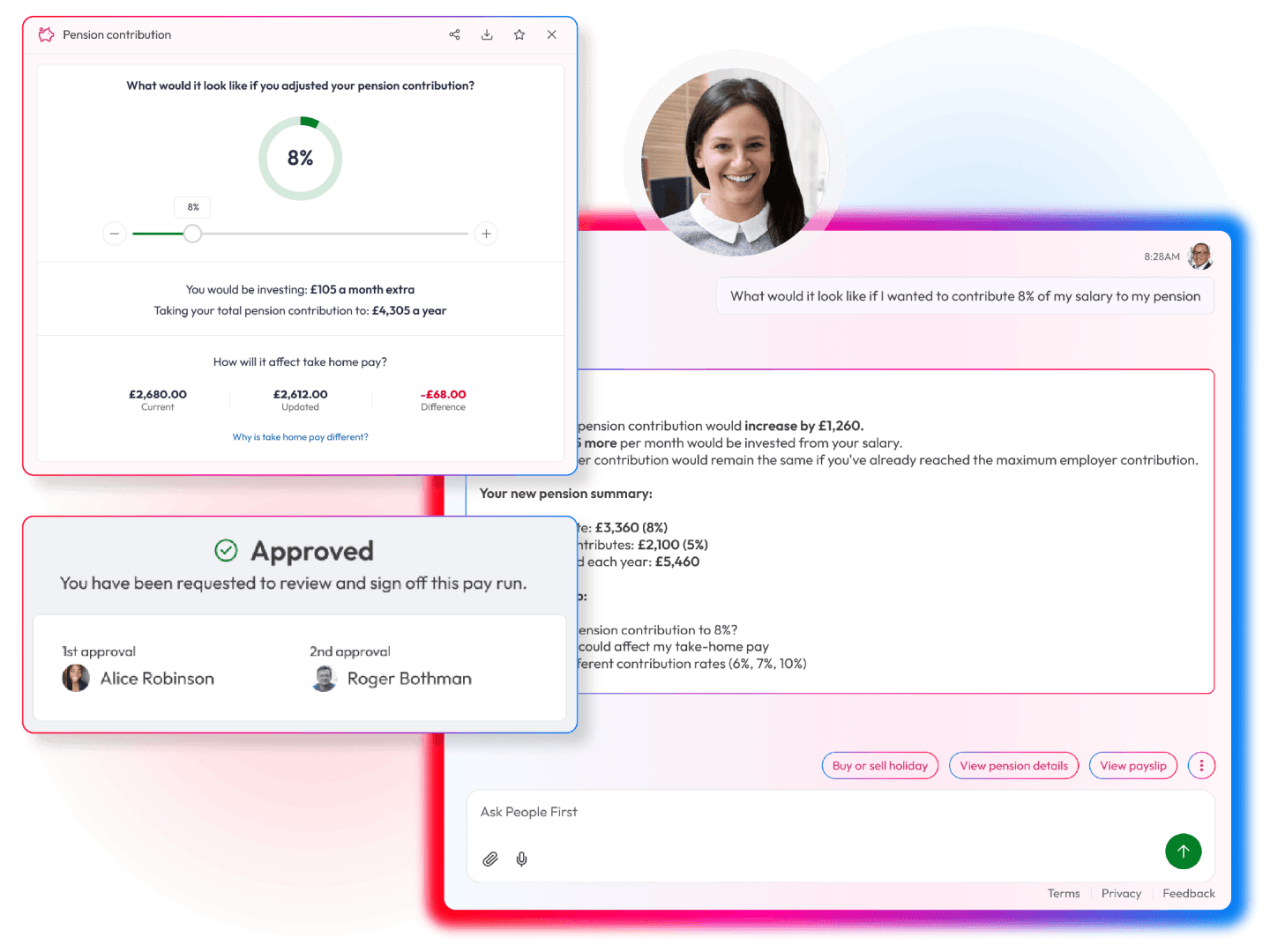
If you’re looking for payroll software that brings HR, payroll and workforce management together, People First is well worth adding to your shortlist.
Key benefits include:
- Unified HR, payroll and workforce management: Work from one source of truth with people and payroll data connected in a single platform.
- Real-time payroll: Payroll recalculates as changes are made, giving your team an up-to-date view throughout the pay period.
- Built in AI-assistance: Ask questions about your HR and payroll data, get information quicker and use AI assistance to make everyday tasks easier.
- Intuitive self-service: Give employees easy to access pay slips and key information through the platform, reducing routine queries.
- Global payroll capability: Manage payroll across multiple countries, with multi-language support for international workforces.
- Backed by MHR expertise: With 40+ years of experience, MHR’s software and managed services process payroll for over 10% of the UK&I workforce.
See what People First could do for your organisation. Book a demo to see it in action: