MHR Labs: AI, rising costs and the job market

Research Engineering Manager Neil Stenton and Senior Data Scientist Chris Judd take a sharp look at how AI continues to impact the job market, and how the rising costs of AI tools could affect your organisation.
In our last blog, we discussed a couple of articles that looked at AI’s impact on the job market from a security perspective and how that might affect developer roles. We also investigated a more positive look into how it may boost employment levels.
Continuing this theme, there are a number of interesting articles this month that take a more measured look at the situation, questioning the impact on jobs based on statistics from the last 18-24 months as well as the futility of trying to predict what might happen next. We’ll also look at how the rising cost of large language models is starting to make AI automation less favourable.
A reality check on AI and the job market by Neil Stenton
Two interesting articles have been published this month: an MIT Technology review piece by David Rotman and an essay from Benedict Evans. The first looks at how official US employment figures don’t quite support the mainstream narrative on how AI is affecting the job market. The second, on an adjacent theme, questions the predictions being made about the disruption and destruction of jobs in the workplace in general, and how looking to past disruptions shows there are always unexpected twists.
The white-collar employment market is in a slump, especially for junior workers and those in the software industry. There have been a number of high-profile announcements from big companies such as Meta, and Oracle and Amazon (laying off 8,000, 10,000 and 30,000 employees respectively), all citing investment in AI as the reason.
Initially, this looks like a doom-laden scenario for those in software engineering at least, but it must be taken, as Kai Riemer and Sandra Peter writing in The Conversation explain, with a pinch of salt. Firstly, many of these companies had a big hiring splurge after the pandemic, and in many cases over-hired. With a downturn in the economy, we are starting to see repercussions around the industry. Secondly, certainly in the case of Meta, this could be less to do with AI and more to do with the failure of their “Metaverse” – which employed around 15,000 people. Finally, it could be marketing hype from the companies trying to improve their standing and stock prices.
There is an undeniable trend in the software developer market, and junior developers are facing the brunt of it. The most startling graph from a recent Stanford Digital Economy Lab paper is particularly revealing, showing the reduction in entry-level software engineering jobs since the introduction of ChatGPT:
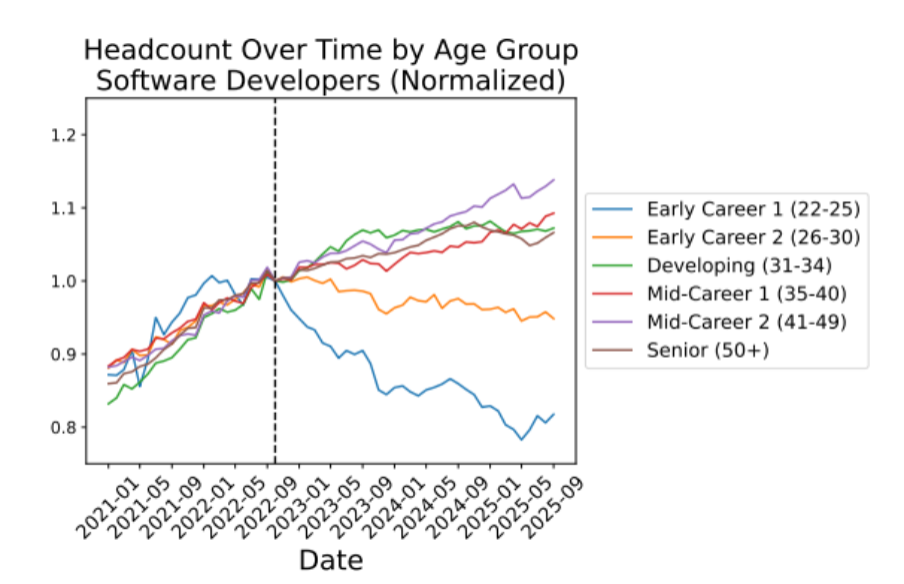
Figure 1. Brynjolfsson, E., Chandar, B., & Chen, R. (2025). Canaries in the Coal Mine? Six Facts about the Recent Employment Effects of Artificial Intelligence. Stanford Digital Economy Lab. https://digitaleconomy.stanford.edu/publications/canaries-in-the-coal-m…
As Rotman points out, it’s interesting that headcounts in more experienced roles continue to increase; whether this is a short-term increase, only time will tell. He also looks at how students are still embracing AI-related careers around computer science, but with a pivot to areas such as data science, cybersecurity and AI itself.
Benedict Evans’ essay, while not exactly dismissive of the fears, takes a different perspective. He questions the over-simplification of using AI automation to replicate jobs that appear straightforward, while in reality, there’s a lot more going on than meets the eye (the graceful swan paddling analogy springs to mind). His essay talks about historical changes in job roles such as accounting which were predicted to be made obsolete by software and automation, whereas these jobs are as popular as ever, and in 2026 an accountant’s role is more complex and nuanced than in 1976.
The interesting theme in both articles is that while we can try to highlight these warnings, predicting the future is a different kettle of fish altogether. Both give examples of how predictions were wrong (radiologists will become redundant) or failed to spot massive disruptions (taxi drivers being impacted by mobile technology).
The research view
There seems to have been a flood of these articles in the last few weeks and sometimes I wonder whether they are trying to find hope in the face of adversity. However, I think Benedict Evans’ essay is especially relevant and honest – we don’t know, they don’t know, and nobody will know until after the event, and then we can all use 20-20 hindsight to predict the past!
The nuances around hidden complexities in seemingly mundane roles and unanticipated market effects on certain jobs is especially revealing and should make us pause for thought about how we think the future will unfold. AI, like blockchain before it, is still a trigger for funding and market manipulation. Even negative company references to AI should be looked at with cynical eyes to determine if there are ulterior motives.
In a way, I do find the increase of these sorts of articles encouraging. It’s good to have more conversations about what this means for employees, what training we all need and perhaps most importantly, how the education systems need to react (and be flexible) to the unpredictability that is AI.
What could it mean for most companies?
All that being said, I believe software developers really are the canaries in the coal mine. Unless the latest models spiral out of control from a cost perspective, even if the LLM technology has reached its peak and doesn’t progress any further, it already is “good enough” to do a lot of coding tasks.
This is a difficult time for those at university or looking for their first software development role, and companies need to keep an open-minded view on the future of software development and on the development of staff. I believe everybody who could be affected by this needs to embrace the technology with a healthy level of scepticism, but embrace it nevertheless.
This is also a difficult time for a lot of companies trying to figure out the best way forward. We still need junior employees because AI (probably) can’t hold the fort on its own when everyone starts retiring. Companies also need to help employees embrace the technology to help themselves and their businesses to prosper.
Rising AI costs by Chris Judd
Recently, there has been a lot of discussion around the cost of AI and whether it may end up being more expensive than simply paying people to do the work manually.
Much of the discussion around this appears to stem from comments made by Uber's management about their use of AI (they have apparently blown through their entire 2026 AI budget already). More broadly though, I’ve been seeing reports of many companies where employees are being encouraged to use AI as much as possible, often incentivised through leaderboards, usage targets, or even suggestions that AI adoption will factor into performance reviews.
The result is an emerging trend known as ‘tokenmaxxing’, where you use AI for as many tasks as possible, often simply to increase usage metrics. Tokens are the units AI systems use to process inputs or outputs, with 1 token being roughly equivalent to 4 characters. In this context longer prompts, longer responses, and more reasoning all use more tokens, and so increase costs.
Unsurprisingly, this can lead to significant waste, with employees applying AI to tasks where it adds little or no value.
Some inefficiencies are inevitable at this stage. Most organisations are still experimenting, trying to understand where AI fits into existing workflows and how to get consistently useful results. This process involves a lot of trial and error, and that carries a cost. As use cases become better understood and best practices emerge, efficiency should improve, but given how broadly applicable AI is, this will take some time.
Pricing changes
Adding to the overuse issue, AI pricing is about to receive a shakeup. It’s been known for a while that subscriptions have been heavily subsidised as providers burn through ludicrous amounts of money to encourage adoption (see Hayden Field's article in The Verge for a good discussion on this). Now that bill may be coming due.
Currently, most AI plans are priced at either a flat-rate subscriptions or simple per-task pricing. This is set to change with many large AI providers moving towards usage-based models built around token consumption. Larger inputs, outputs and more complicated reasoning steps all use more tokens and so cost more to run. This move is expected to increase overall usage costs and could be particularly problematic for businesses encouraging widespread, unrestricted AI use.
The research view
Many of the problems in AI spending can be resolved by ensuring incentives are aligned to what you are actually trying to achieve. Tracking AI usage alone tells us very little about whether employees are using it productively, and based on some of the reports, it seems that measuring usage as a success metric can actively encourage wasteful behaviour.
There also needs to be a balance between exploration and optimisation. Organisations still need to invest in experimentation to find the best applications of AI, and upskilling employees remains essential. Even with rising costs, AI is unlikely to go anywhere. At the same time, businesses need to develop a clearer understanding of where AI generates meaningful value.
Finally, communication is often overlooked. Are employees being taught what good AI usage looks like, or are they simply being told to use it more? Do they understand the costs associated with different tools? AI chat interfaces are highly abstracted, making it easy to treat them like any other software application without considering the underlying costs.
As AI providers look to recover the substantial investments they have made, organisations that focus on outcomes rather than usage metrics, educate employees on effective AI adoption, and build discipline around where AI is applied will be far better positioned to manage these changes.
Share this article