Image

This guide outlines how to integrate an Applicant Tracking System (ATS) to People First Onboarding, transferring successful candidates in readiness for enabling their onboarding journey. For organisations who do not use the People First Recruitment module, bringing these two systems together will streamline the hiring process for both HR and recruitment teams, ensure a seamless transition from candidate selection to employee onboarding, and accelerate time-to-productivity for new hires.
This document assumes the reader has knowledge of People First terminology and is familiar with API authentication methods, general API usage, and HTTP status codes.
References:
If possible, store the job title alongside the corresponding ID within the ATS, so that when the applicant gets appointed, we know which People First job they will be entering. Job IDs are preferred over job titles because the former will be unique whilst the latter may not be.
In the following sections, PFBASEURI refers to "People First Base URI" – see "Note:" under API Requests Section.
In the API calls, date values are specified in format YYYY-MM-DD and IDs follow the uuid convention (32 hexadecimal characters).
Error codes – successful requests will return status codes of 200 or 201. API calls which return 400 means the body of the request has something wrong with it. API calls which return 401 or 404 generally mean there is an authorisation issue.
Note: All example API calls in this document contain sample data.
To make use of these API calls, the ATS will need to use a Personal Access Token (PAT) generated from People First.
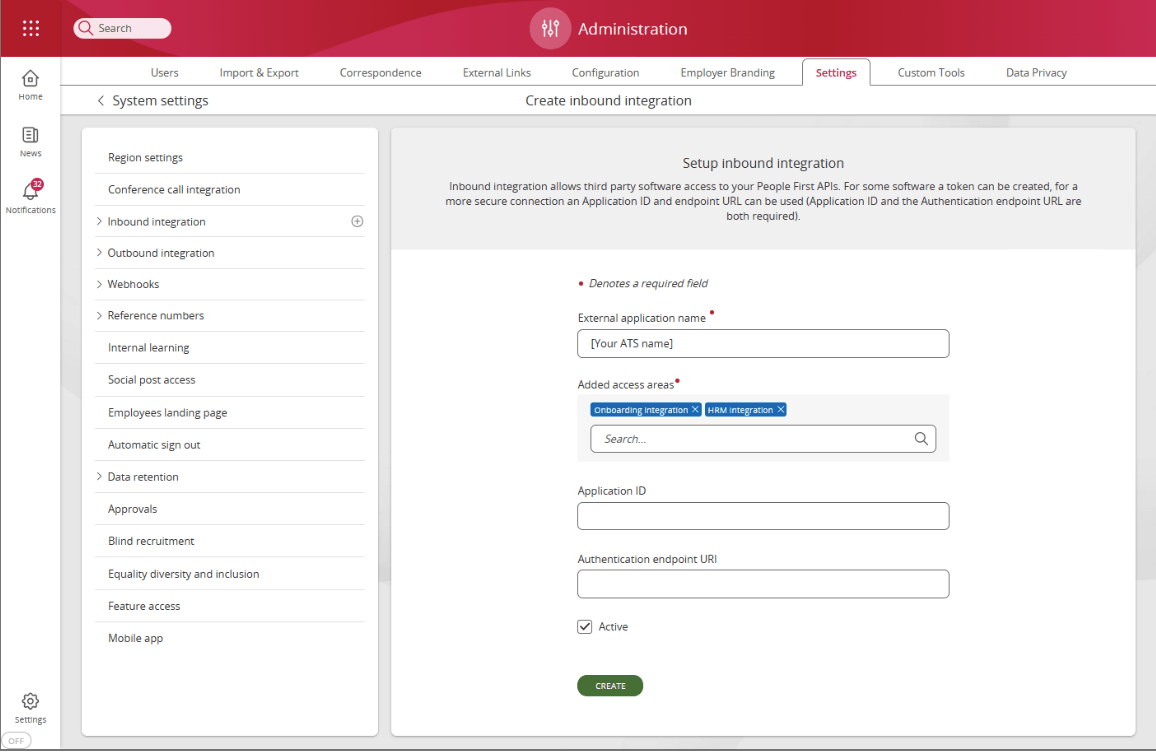
When creating the new PAT token, we should select access to "Onboarding Integration" and "HRM Integration" as shown above to access the Onboarding API calls and the job search API calls respectively.
See: REST API Integration for generating PAT token.
This PAT should be included as the value of the "Authorization" HTTP header.