The great performance divide
Mismatched thinking among organisational leaders and employees
Leaders in core functions and their employees are not aligned on how they think about high performance in their organisations. That’s the case not only in how they define what high performance looks like, but also in which areas they think their organisation is strongest or weakest, which areas they want to improve, or what benefits they think it brings. In every instance, leaders and employees are at odds with each other.
Their mismatched interpretations are likely to be a blocker to success. They also highlight deeper challenges facing many organisations, in terms of productivity and ambition.
Because while employees are broadly positive about the performance of themselves, their team and their wider organisations, leaders are far less confident about their situation now and more anxious about the future.
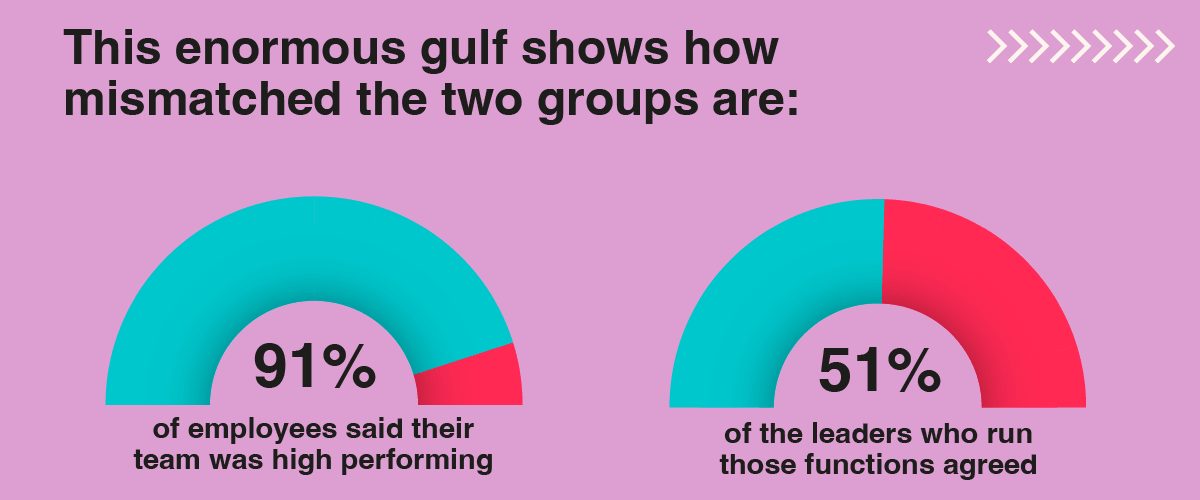
This is encapsulated in one stark statistic. While 91% of employees said their team was high performing, just 51% of the leaders who run those functions agreed. That enormous gulf shows how mismatched the two groups are. Even for their overall organisations, 91% of employees thought they were high performing, compared to only 79% of leaders.
Analysing the root cause of disparities
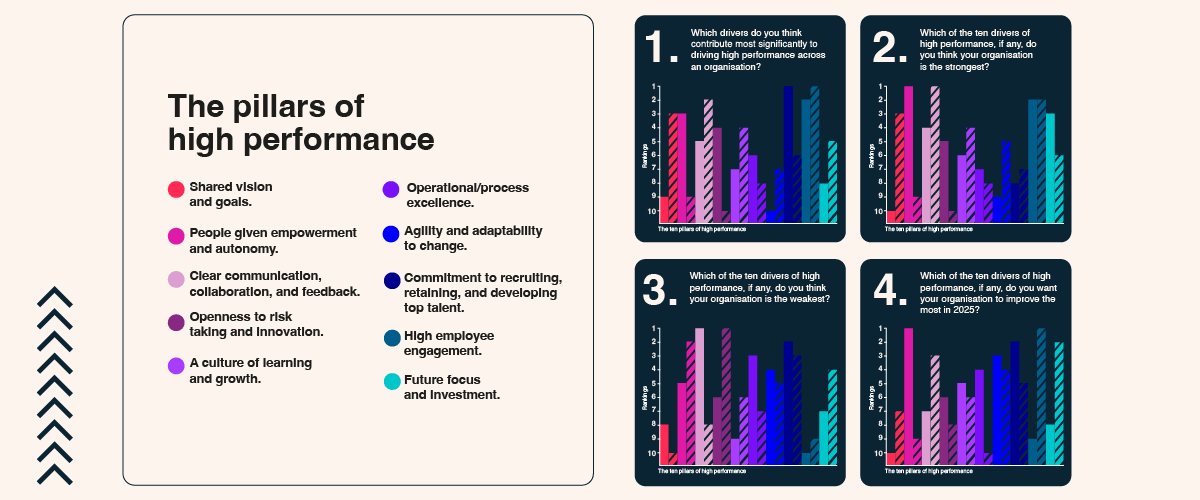
We see a similar disparity in how the two groups rate which drivers of high performance do or don’t contribute to the success of their organisation. The factor that employees think their 51% of the leaders who run those functions agreed organisation is strongest at – clear communication, collaboration and feedback – is precisely what leaders think they are weakest at. And the factor that leaders think they’re strongest at – giving people empowerment and autonomy – is second place in employees’ weakest list.
Employees aren’t aware of the depth of this disconnect either. While 66% of workers feel that the employees and leadership in their organisation are aligned about what high performance looks like, just 45% of leaders agreed.
We have a long way to go in getting shared understanding of what high performance looks like and how to make it happen. It starts with analysing the root causes of this mismatched thinking.
Lost in translation
Leaders and employees speak a different language about the drivers and benefits of high performance
Our research shows that employees and leaders view high performance differently, based on their position within the organisation. They fundamentally see this issue through two different lenses.
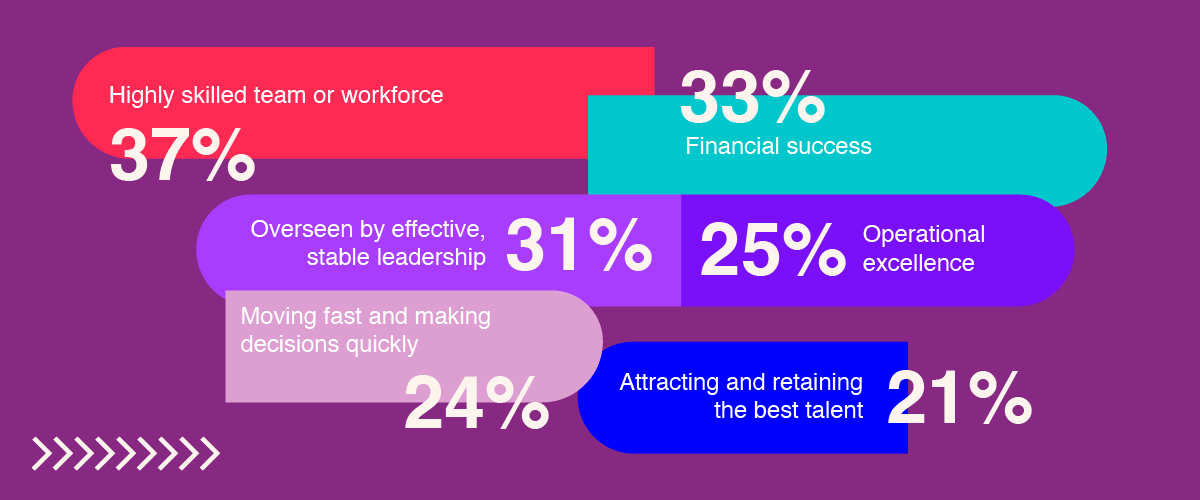
For employees, the most important factors in achieving high performance are a highly skilled team or workforce (37%), overseen by effective, stable leadership (31%), which together create financial success (33%). But for organisational leaders, high performance is about operational excellence (25%), moving fast and making decisions quickly (24%), and attracting and retaining the best talent (21%).
In other words, employees believe that stability and predictability create the conditions for high performance, whereas leaders prioritise the need to be agile and fast-paced.
Employees value higher engagement, which incurs more managerial time; leaders value autonomy and empowering people to move quickly. For employees, high performance is a well-oiled machine humming along nicely; for leaders, potentially disruptive factors like an openness to risk taking and innovation are more important.
What's to blame?
When high performance isn’t achieved, employees tend to pin the blame on a lack of individual skills (25%), whereas leaders cite structural factors such as issues with the organisation’s culture (29%) or lack of access to the right information and data (24%).
The two groups are also in disagreement about the ultimate benefits of high performance. Organisational leaders want it to bring about greater market share, higher employee wages, and higher profits. Workers believe high performance should lead to happier employees, followed by higher wages, and greater productivity.
Uncertain leaders
How bosses lack confidence
Underlying these disparities between leaders and employees in core functions is one striking fact: the leaders are full of uncertainty and doubt when it comes to high performance in the workplace. And they’re significantly more anxious about it than their teams are.
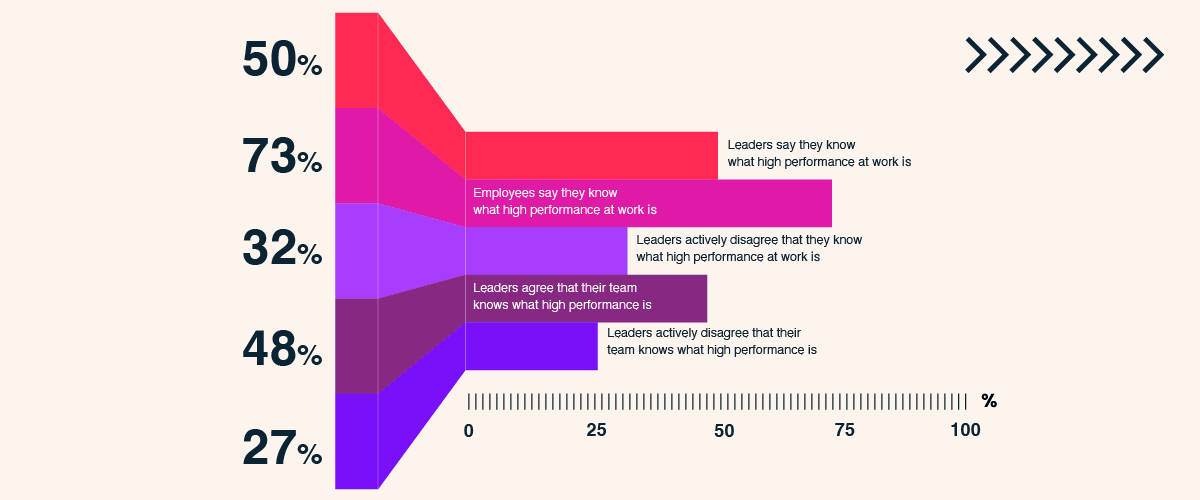
For example, only 50% of organisational leaders say they know what high performance at work looks like, compared to 73% of employees. In fact, 32% of leaders actively disagree that they know. Leaders aren’t especially positive about their teams either: less than half (48%) agree that their team knows what high performance looks like, while 27% actively disagree.
Lack of clarity
Only 47% of organisational leaders said they have a clear understanding of what creates high performance. They aren’t always helped by their CEOs in this. In fact, 25% of leaders say that their CEO doesn’t know what high performance looks like, and 27% say that their CEO doesn’t help them achieve it. In sum, a lack of clarity about the definition and drivers of high performance appears to be breeding low levels of confidence and is ultimately holding organisations back.
There’s something else on the minds of bosses too: grappling with managing multiple generations in the workplace. They are mostly positive about this situation, but significant minorities report that it brings challenges. For instance, while 49% say having multiple generations contributes positively to the overall success of their organisation, 25% disagree. Similarly, 49% agree multiple generations make high performance easier, but 31% disagree. More worryingly, 47% agree that having multiple generations stifles creativity and innovation, and 51% say communication gaps across generations impact performance.
A deep dive into the pillars of high performance
Inspired by the work from André de Waal and other academics. These infographics highlight the conflict of opinions between leaders and employees.
Anxious outlook
Differing views on prospects for 2025
This mismatch in thinking between leaders and employees carries over into their views on 2025 too. Nearly two in three employees (66%) believe their organisation will be high performing this year, yet only 41% of leaders felt the same. Indeed, nearly half of leaders (49%) are worried about their organisation’s ability to be high performing in 2025, compared to just 25% who are unconcerned.
Many leaders even doubt their organisation can make progress on the year just gone. One in three (33%) don’t expect their organisation’s performance to improve in 2025 compared to last year, while just 42% believe it will.
That makes it all the more surprising that employees are so confident in the ability of their leadership to deliver high performance this year. Indeed, they’re far more confident than leaders themselves. Nearly one in three employees (30%) said they were extremely confident that their bosses will deliver high performance in their organisation in 2025. But just one in six leaders (17%) felt the same.
Challenging economic climate
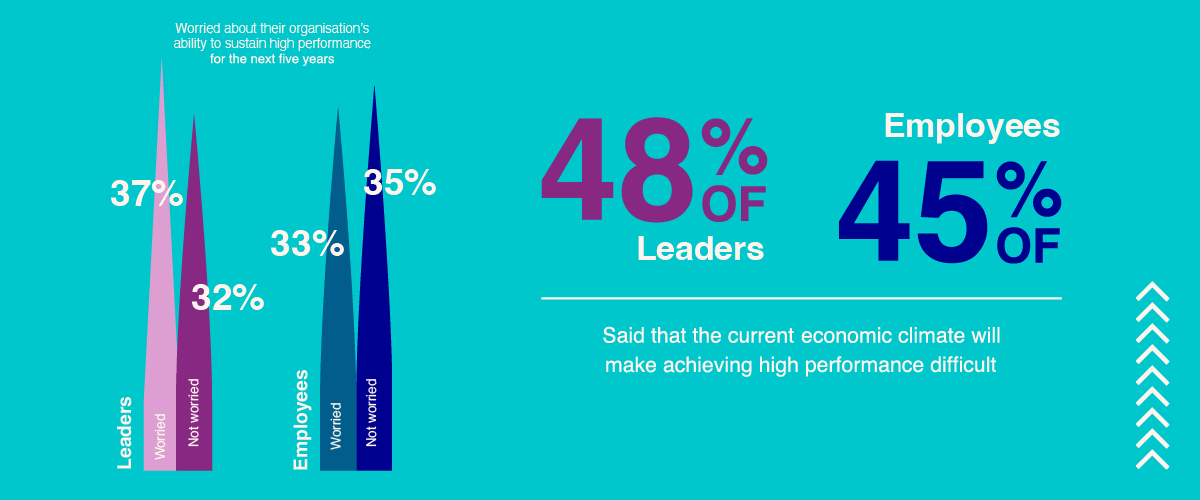
This lack of confidence might in part be because of the broader economic environment right now. A plurality of both leaders (45%) and employees (48%) said that the current economic climate will make achieving high performance difficult.
Looking further ahead, 37% of leaders say they’re worried about their organisation’s ability to sustain high performance for the next five years, against 32% who aren’t worried. In comparison, 33% of employees are worried about this but 35% aren’t.
What’s clear is that workers want to reach greater heights. Nearly two-thirds of them (64%) say that businesses need to be more ambitious when it comes to growth. That compares to somewhat fewer leaders (47%), although still a plurality.
Tech matters
How the right data helps power performance
Technology is universally recognised as a vital factor in helping organisations to achieve high performance: 100% of leaders and 99% of employees say this is the case. But perhaps surprisingly, employees seem more enthusiastic about the importance of specific technologies than their organisational leaders do. That may be because leaders are more likely to think that tech alone isn’t enough – it’s what you do with it that really matters.
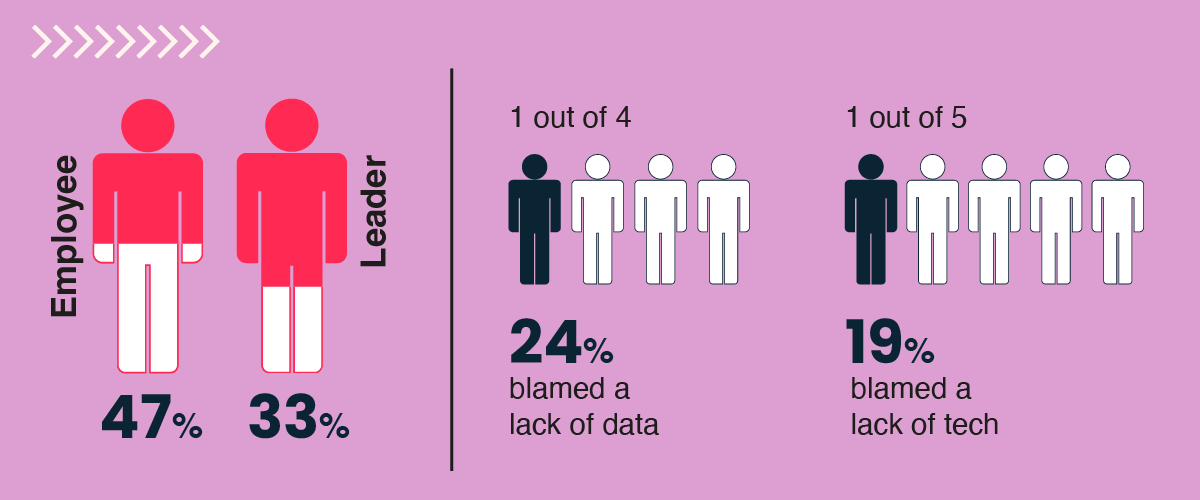
So while both groups say that HR software, financial software and collaboration tools are all vital technologies in driving high performance, more employees believe this (47%) than leaders (33%).
Likewise, employees (56%) are slightly more likely than leaders (48%) to agree that their organisation would perform better if it invested more in technology. And more employees (59%) than leaders (47%) think extra investment in collaboration and communication would boost performance levels too.
Using data to create value
Where we see a dichotomy is in how employees view the impact of data. Most employees (69%) believe it’s impossible to improve an organisation’s performance levels without having access to real-time data and insights. Yet when employees who don’t work in high-performing organisations were asked what’s blocking them, this didn’t shine through.
Only 17% of these employees blamed the lack of access to the right tech and tools, and a mere 6% pointed to a lack of access to the right data. This is counter to the perspective of leaders – one in four (24%) of them blamed a lack of data, and one in five (19%) blamed a lack of tech. For leaders, it’s getting the right data to make smart and fast decisions that matters – much more than just the tools or systems on their own.
The power of AI
Employees who work with their organisation’s technology systems, day-in and day-out, certainly value their impact. Roughly four in five of them (78%) agree that in a high-performing team, work flows seamlessly between people. And a similar number (74%) regularly feel “in the zone” in their jobs.
They’re also aware of technological changes coming down the track. A majority of employees (55%) think that AI will totally change how their organisation operates over the next five years – a slightly higher proportion than among leaders (49%). Likewise, 57% of employees think that the nature of high-performing organisations is changing with the introduction of AI, compared to 49% of leaders. But the views of organisational leaders are clear: regardless of the tools or systems used, what’s most vital is accessing data quickly and unlocking insights from it.
Conclusion
High performance organisations aren't built in silos - they are forged in unity
Public and private sector organisations are navigating a world of work that is changing more than ever before. Leaders’ and workers’ goals are perennial – they still want efficiency, productivity, growth and impact – but the way they achieve them now requires a fresh approach.
It means building and sustaining a high performance organisation is not straightforward, particularly as leaders’ and workers’ views of what this looks like can often be at odds. This misalignment can happen across business processes, people management, technology and culture which ultimately hinders organisational success.
Embedding the principles of existing high-performance organisations across more firms is important to bring about positive change and success. Key to making this happen are core operating functions such as HR, payroll and finance – the critical teams in every organisation who enable efficient working and smarter decision-making.
These teams and the broader organisation must be united with leadership on what high performance looks like and how it can be delivered. To achieve this, a shared vision, the right tools, and effective communication are critical to addressing misalignments and building a sustainable high performance organisation.
Based on this research, we've put together 8 actionable strategies to ensure high performance success in your teams.